Xi’an Biang Biang Noodles: Belt-Wide & a 58-Stroke Name
- What Exactly Are Xi'an Biang Biang Noodles?
- The Character “Biang”: A Silk Road Totem That Doesn’t Fit in the Dictionary
- The Bowl of Noodles from Shaanxi’s “Eight Oddities”
- Biang Biang Noodles vs. Liangpi vs. Lanzhou Lamian vs. Daoxiao Noodles
- How to Order Xi'an Biang Biang Noodles in Xi'an Without Making a Mistake
- From Xianyang to New York: A Global Journey Through a Bowl of Noodles
- Three-in-One Oil-Splashed Noodles: How to Recreate Them at Home
- FAQ
“Biang—biang—” In the kitchen of an old Xi’an restaurant, the chef pinches both ends of the rolled-out dough and slams it down on the cutting board—the sound is as crisp as firecrackers going off. Immediately afterward, a spoonful of smoking-hot rapeseed oil is splashed with a “sizzle” onto the chili powder and minced garlic, sending up a red cloud of steam that fills the entire street with its aroma. The first time I ate Xi’an biang biang noodles in Xi’an, I was captivated by the sound and the aroma—and what’s even more surprising is that I couldn’t even spell the name of this dish.
What Exactly Are Xi’an Biang Biang Noodles?
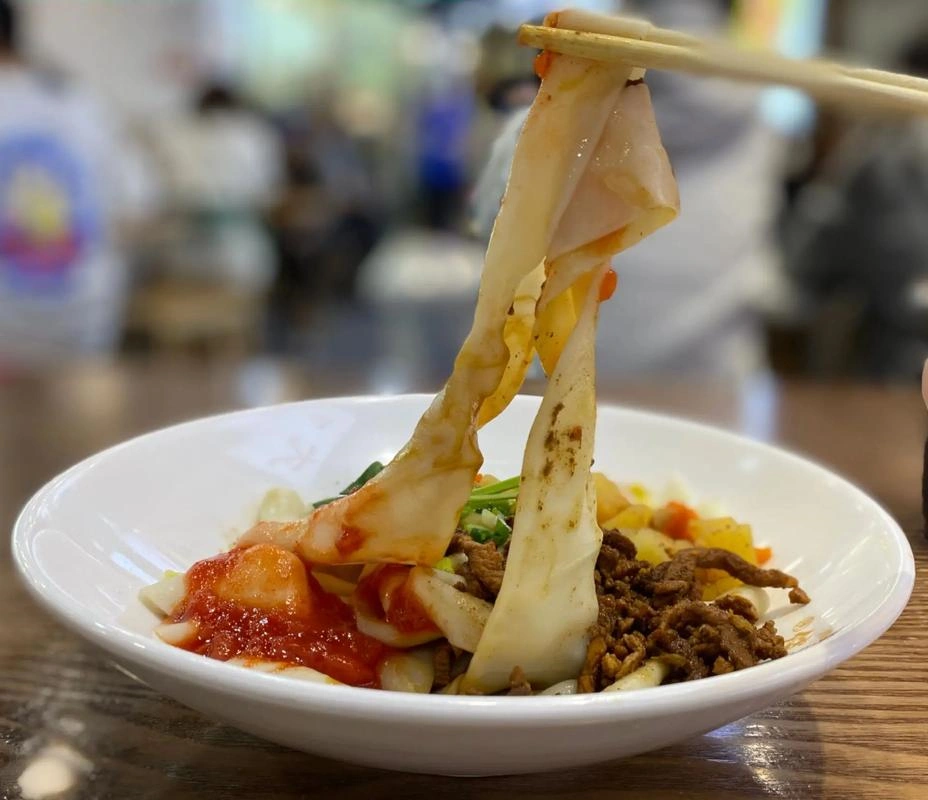
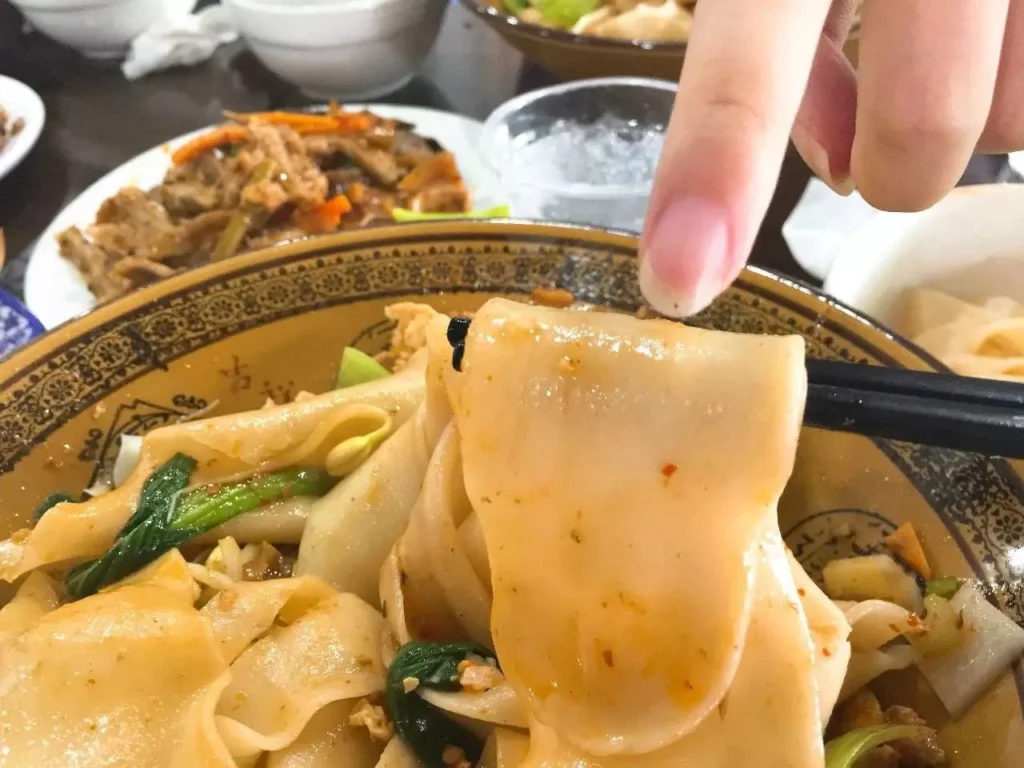
Simply put, Xi’an Biang Biang noodles are a traditional hand-pulled noodle dish from the Guanzhong region of Shaanxi; they are also known as “belt noodles” or “oil-splashed pulled noodles.” “Biang” is an onomatopoeic character that mimics the “biang! biang!” sound made when the dough is slammed against the cutting board, so the name itself describes the preparation process. The noodles are as wide as a belt, thick and chewy, with individual strands stretching from half a meter to one meter in length and three to six centimeters in width. When you take a bite, they’re springy and chewy. Among the “Eight Wonders of Shaanxi,” they rank first—“noodles as wide as a belt.” As for the “biang” character (the one that’s hard to write), I’ll break it down for you later in this article.
The Character “Biang”: A Silk Road Totem That Doesn’t Fit in the Dictionary
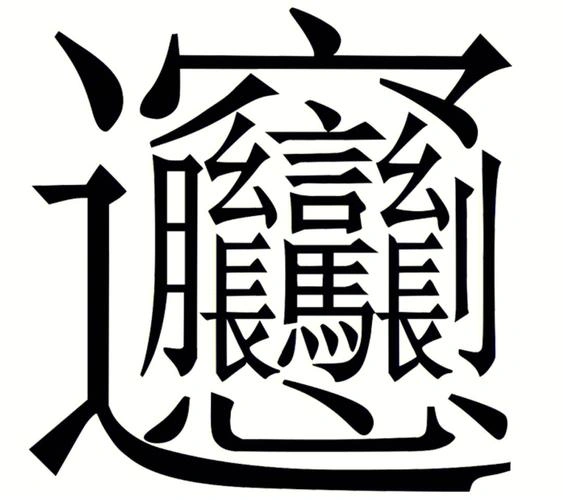
This is the part of the article I’m most eager to discuss, and it’s also what makes the “biang” character so fascinating. Many international foodies search for “Xi’an biang biang noodles” for the first time simply to figure out that character. The traditional form of the character “biang” consists of 58 strokes and is widely recognized as one of the most difficult Chinese characters to write. It wasn’t even included in the Xinhua Dictionary or the Kangxi Dictionary until 2020, when it was finally added to Unicode. But don’t assume it’s just a random jumble of strokes—this character is actually a condensed map of Xi’an’s history and geography.
Look at its components: it contains “silk” (silk), “horse” (the mode of transportation on the Silk Road), and “long” (referring both to the length of the Silk Road and the length of the noodles). Xi’an is the eastern starting point of the Silk Road, and the people of Guanzhong revere the “biang” character as a kind of folk totem. In 2011, the craft of making biangbiang noodles was listed as part of Shaanxi Province’s intangible cultural heritage.
There are two folk legends about the origin of this character. One says that during the Qin Dynasty, a poor scholar who couldn’t afford to pay for his noodles invented the character on the spot to settle his debt; the other says that Emperor Qin Shi Huang, while ill, found these noodles appetizing and, on a whim, created the character with a stroke of his brush. Regardless of which story is true, the mnemonic for writing the character really does help you “master” it: “A dot flies up to the sky, the Yellow River bends twice; open wide like the character ‘八,’ the character ‘言’ goes inside; twist left, twist right; stretch west, stretch east, with ‘马大王’ sandwiched in the middle; a ‘心’ at the bottom, a ‘月’ on the side; leave a hook to hang some sesame candy, push a cart and stroll through Xianyang.” “Once you’ve recited this, the structure of the 58 strokes will be fully imprinted in your mind. By the way, “biang biang noodles” is pronounced “biáng biáng mian”—many foreigners get tripped up by the force of the retroflex consonant.
The Bowl of Noodles from Shaanxi’s “Eight Oddities”
Many people are only familiar with the oddity that “noodles are as thick as a belt,” but they don’t realize that behind Xi’an biang biang noodles lies an entire philosophy of life for the people of Guanzhong. Among the “Eight Wonders of Shaanxi,” another noodle-related oddity is “eating while squatting instead of sitting on a stool”—old-school Shaanxi locals love to hold a large bowl and squat by the doorway to enjoy their noodles to the fullest; “eating noodles with garlic” is a standard practice—biting into a raw garlic clove cuts through the richness and enhances the flavor; and after finishing the noodles, one must “use the broth to wash down the meal,” taking a sip of the hot noodle broth to “fill the gaps.” These living folk customs are rarely mentioned in competing articles, yet they are the key to understanding this bowl of noodles. If you follow this thread, Xi’an’s three-thousand-year history will reveal why Guanzhong is known as the granary of the “800-li Qin Valley.”
Biang Biang Noodles vs. Liangpi vs. Lanzhou Lamian vs. Daoxiao Noodles
People often confuse Shaanxi noodle dishes, and the question about biang biang noodles versus liangpi (凉皮) comes up most frequently. Stop thinking of biang biang noodles and liangpi as the same thing—I’ll draw a clear line between them based on their preparation methods:
- Biang biang noodles vs. liangpi: Liangpi is made by steaming a starch batter into thin sheets after the gluten has been washed out, and is served cold at room temperature; Xi’an biang biang noodles are wide noodles pulled by hand and served hot. Both are tossed with chili oil, but one is cold and the other is hot, one is steamed and the other is pulled—they are completely different dishes.
- vs. Lanzhou Lamian: Lanzhou lamian features thin, round noodles in a clear, plain broth. The noodles are formed by folding and pulling the dough into multiple strands, following the principle of “first clear, second white, third red, fourth green.” Biangbiang, on the other hand, consists of wide, belt-like noodles tossed dry with chili oil. The noodles are hand-pulled into single strands and then torn in half along the creases, resulting in a rich, spicy, and hearty dish.
- vs. Knife-Shaved Noodles (dao xiao): Knife-shaved noodles are made by resting the dough on the forearm and shaving it into the pot with a curved knife, resulting in a wedge-shaped cross-section; biangbiang is pulled by hand. In a nutshell—pulling vs. shaving—that’s the clearest distinction.
Along with roujiamo and liangpi, it’s considered one of Shaanxi’s “Big Three,” and locals often pair it with a bottle of Bingfeng soda. Remember, the biggest difference between biang biang noodles and liangpi is the temperature—one is pulled while hot, and the other is steamed while cold. You can also find recommendations for other must-try Xi’an dishes on our “Must-Eat” list.
How to Order Xi’an Biang Biang Noodles in Xi’an Without Making a Mistake
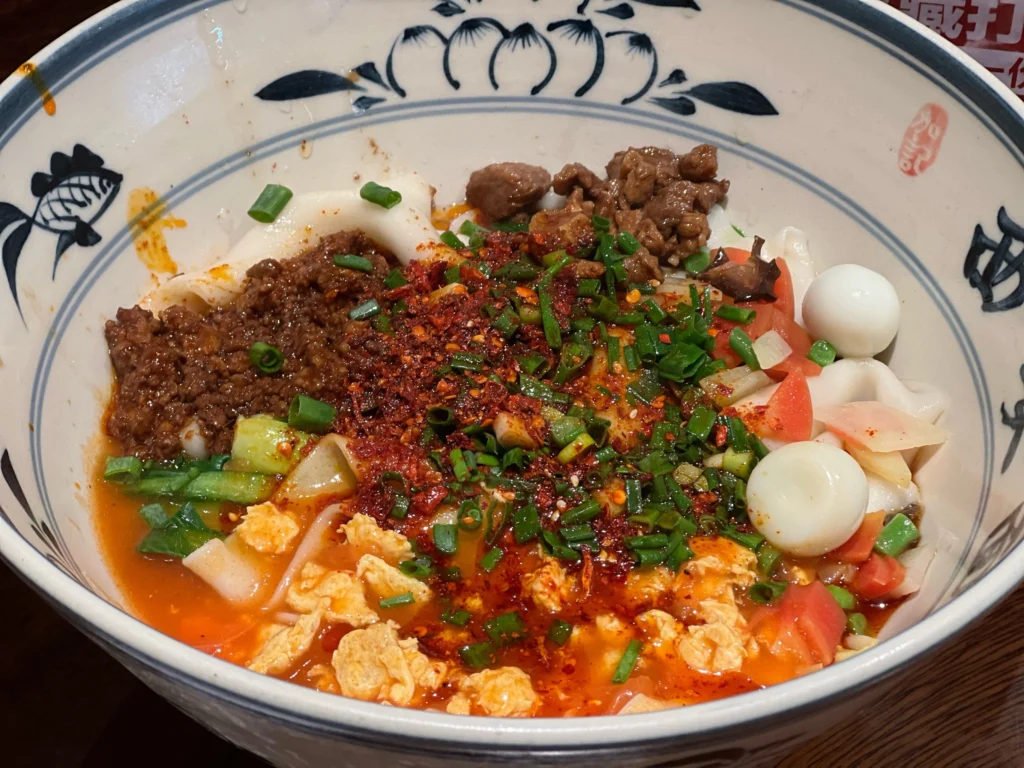
I visited several long-standing restaurants in Xi’an and found that ordering Xi’an biang biang noodles is simpler than I expected. Here’s a quick guide to help you out. If it’s your first time, just ask for “Three-in-One” (sanheyi): minced pork topping + tomato and egg + oil-splashed sauce. It offers the most complete flavor profile—you can’t go wrong even if you order with your eyes closed. If you want to experience the authentic flavor, go for the plain oil-splashed (youpo) version, which relies solely on chili flakes, garlic, and vinegar for its flavor; If you can’t handle spice, ask the owner to go easy on the chili flakes—the tomato and egg topping in the “Three-in-One” will help cut the heat. For those wondering if biang biang noodles are vegan, just order the vegetarian version (carrots, potatoes, tofu, wood ear mushrooms, and lily buds)—the sauce base is already completely vegan.
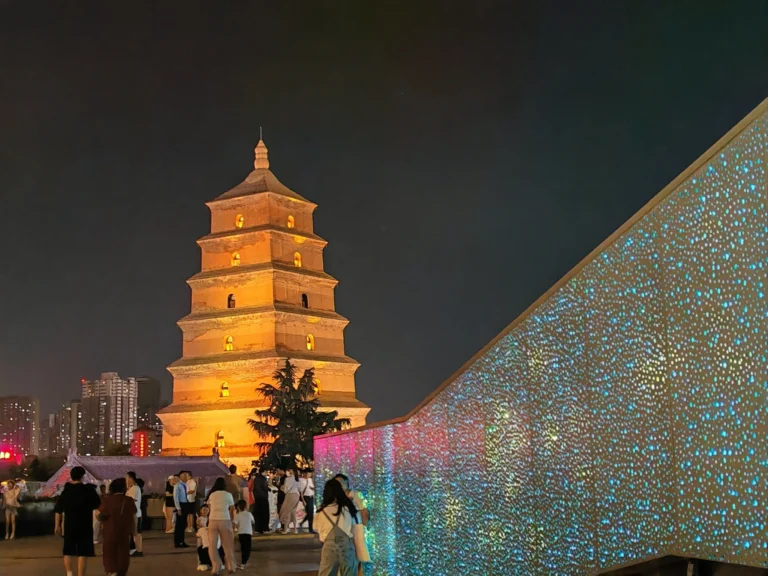
As for restaurants, my top recommendation for the best biang biang noodles in Xi’an is Ai Hua Biang Biang Noodle House in the Bell Tower neighborhood—a 20-year-old institution that’s been featured on A Bite of China. Their “Three-in-One” biang biang noodles cost just over 20 per person. [Lao Bai Jia Noodle House] on East Surveying Road is a 36-year-old neighborhood staple and the go-to spot for locals’ work lunches; Guo Laosan Noodle House, next to the Big Wild Goose Pagoda, is a great spot to grab a bite after sightseeing. If you want an immersive experience watching the noodle-throwing performance and even try your hand at writing the character “biang,” the Nan Yuanmen branch near Hui Muslim Street is the best choice. When it comes to eating noodles, a culinary tour of Hui Muslim Street is a whole other story in itself. Combining a walking route that connects the Xi’an City Wall with Hui Muslim Street—eating as you go—is the authentic way to experience old Xi’an. When it comes to where to eat biang biang noodles in Xi’an, remember this rule of thumb: the trendy spots packed with tourists aren’t necessarily the best; it’s the old neighborhood spots tucked away in the alleys that really show their true colors.
From Xianyang to New York: A Global Journey Through a Bowl of Noodles
Decades ago, Xi’an biang biang noodles were just a local snack in the Guanzhong region. The turning point came when social media sparked curiosity about the “biang” character, coupled with a 2021 BBC article titled “Xi’an Cuisine: A Chinese Noodle Dish Whose Name Can’t Be Written,” which further fueled the trend—suddenly, it became a global internet sensation.
The overseas versions are also quite interesting: Xi’an Famous Foods started in a basement in Flushing, New York, in 2005 and now operates more than a dozen locations, having gained popularity thanks to its cumin lamb hand-ripped noodles, which were made famous by Anthony Bourdain; London’s Ao Ao Xi’an Noodle House draws crowds willing to wait in line for an hour; Tokyo’s Qin Tang Ji opened the city’s first specialty Shaanxi noodle shop in 2018; even Japan’s Sanseido National Language Dictionary included an entry for the term in 2021. The success of Xi’an Famous Foods shows that a bowl of noodles can travel from a street cart in Xianyang to the other side of the globe—not through marketing, but thanks to that “biang” sound and that spoonful of hot oil. Today, when people overseas ask for the “best biang biang noodles restaurant in Xi’an,” the answer is almost always one of the branches of Xi’an Famous Foods.
Three-in-One Oil-Splashed Noodles: How to Recreate Them at Home
If you want to recreate authentic “oil-splashed” wide noodles, making Xi’an biang biang noodles yourself isn’t difficult: mix medium-high-gluten flour with salt and water, knead three times, let rest for at least two hours—it needs to be fully rested to stretch properly. Roll it out into an oval shape, press a groove down the center, then pull and slap the dough with both hands while tearing it along the groove into two strands. Boil in boiling water for two to three minutes until they float to the surface—that’s when they’re done. Pile minced garlic, chopped scallions, and chili flakes on top of the noodles, then pour in rapeseed oil heated until it’s smoking (this is the essence of the “oil-splashed” technique). Finally, drizzle aromatic vinegar and light soy sauce along the rim of the bowl—and there you have it: a quartet of flavors—spicy, sour, fragrant, and savory. For the “three-in-one” toppings, stir-fry the minced pork and tomato-egg mixture in advance, then mix it in just before serving. Are biang biang noodles vegan? The basic oil-splashed sauce is already vegan; simply omit the minced pork, and you can enjoy them with confidence.
FAQ
Next time you visit Xi’an, be sure to try a bowl of Xi’an biang biang noodles. From the sound of the dough being slapped to the sizzle of the hot oil, from the 58 strokes of the character that defy description to the old Shaanxi locals who squat at the door munching on garlic—this bowl of noodles actually encapsulates the 3,000-year-old spirit of the entire city.